


Page 16 - Demo
P. 16
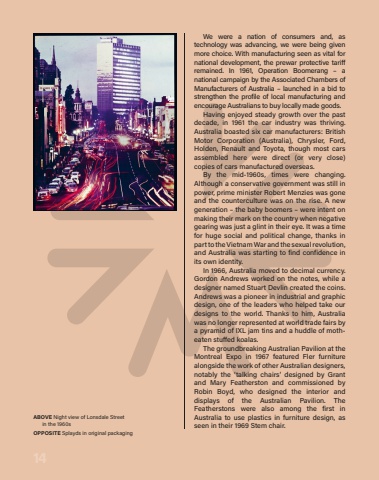
14We were a nation of consumers and, as technology was advancing, we were being given more choice. With manufacturing seen as vital for national development, the prewar protective tari%u00a0 remained. In 1961, Operation Boomerang %u2013 a national campaign by the Associated Chambers of Manufacturers of Australia %u2013 launched in a bid to strengthen the profile of local manufacturing and encourage Australians to buy locally made goods.Having enjoyed steady growth over the past decade, in 1961 the car industry was thriving. Australia boasted six car manufacturers: British Motor Corporation (Australia), Chrysler, Ford, Holden, Renault and Toyota, though most cars assembled here were direct (or very close) copies of cars manufactured overseas.By the mid-1960s, times were changing. Although a conservative government was still in power, prime minister Robert Menzies was gone and the counterculture was on the rise. A new generation %u2013 the baby boomers %u2013 were intent on making their mark on the country when negative gearing was just a glint in their eye. It was a time for huge social and political change, thanks in part to the Vietnam War and the sexual revolution, and Australia was starting to find confidence in its own identity. In 1966, Australia moved to decimal currency. Gordon Andrews worked on the notes, while a designer named Stuart Devlin created the coins. Andrews was a pioneer in industrial and graphic design, one of the leaders who helped take our designs to the world. Thanks to him, Australia was no longer represented at world trade fairs by a pyramid of IXL jam tins and a huddle of motheaten stu%u00a0 ed koalas.The groundbreaking Australian Pavilion at the Montreal Expo in 1967 featured Fler furniture alongside the work of other Australian designers, notably the %u2018talking chairs%u2019 designed by Grant and Mary Featherston and commissioned by Robin Boyd, who designed the interior and displays of the Australian Pavilion. The Featherstons were also among the first in Australia to use plastics in furniture design, as seen in their 1969 Stem chair.ABOVE Night view of Lonsdale Street in%u00a0the%u00a01960sOPPOSITE Splayds in original packaging


