


Page 73 - Demo
P. 73
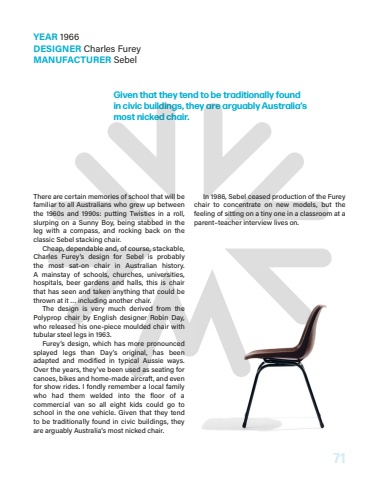
71Given that they tend to be traditionally found in civic buildings, they are arguably Australia%u2019s most nicked chair.There are certain memories of school that will be familiar to all Australians who grew up between the 1960s and 1990s: putting Twisties in a roll, slurping on a Sunny Boy, being stabbed in the leg with a compass, and rocking back on the classic Sebel stacking chair. Cheap, dependable and, of course, stackable, Charles Furey%u2019s design for Sebel is probably the%u00a0 most sat-on chair in Australian history. A%u00a0 mainstay of schools, churches, universities, hospitals, beer gardens and halls, this is chair that has seen and taken anything that could be thrown at it %u2026 including another chair. The design is very much derived from the Polyprop chair by English designer Robin Day, who released his one-piece moulded chair with tubular steel legs in 1963.Furey%u2019s design, which has more pronounced splayed legs than Day%u2019s original, has been adapted and modified in typical Aussie ways. Over the years, they%u2019ve been used as seating for canoes, bikes and home-made aircraft, and even for show rides. I fondly remember a local family who had them welded into the floor of a commercial van so all eight kids could go to school in the one vehicle. Given that they tend to%u00a0be traditionally found in civic buildings, they are arguably Australia%u2019s most nicked chair.YEAR 1966DESIGNER Charles FureyMANUFACTURER SebelIn 1986, Sebel ceased production of the Furey chair to concentrate on new models, but the feeling of sitting on a tiny one in a classroom at a parent%u2013teacher interview lives on.


