


Page 21 - Demo
P. 21
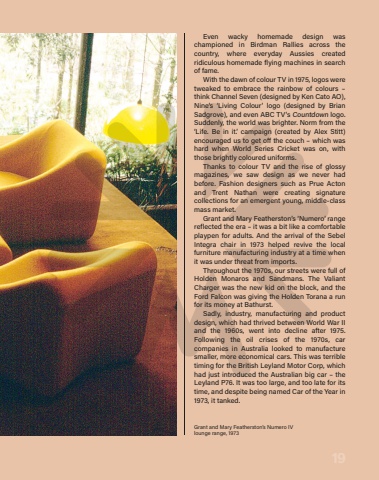
19Even wacky homemade design was championed in Birdman Rallies across the country, where everyday Aussies created ridiculous homemade flying machines in search of fame.With the dawn of colour TV in 1975, logos were tweaked to embrace the rainbow of colours%u00a0 %u2013 think Channel Seven (designed by Ken%u00a0Cato AO), Nine%u2019s %u2018Living Colour%u2019 logo (designed by Brian Sadgrove), and even ABC TV%u2019s Countdown logo. Suddenly, the world was brighter. Norm from the %u2018Life. Be in it.%u2019 campaign (created by Alex Stitt) encouraged us to get o%u00a0 the couch %u2013 which was hard when World Series Cricket was on, with those brightly coloured uniforms.Thanks to colour TV and the rise of glossy magazines, we saw design as we never had before. Fashion designers such as Prue Acton and Trent Nathan were creating signature collections for an emergent young, middle-class mass market. Grant and Mary Featherston%u2019s %u2018Numero%u2019 range reflected the era %u2013 it was a bit like a comfortable playpen for adults. And the arrival of the Sebel Integra chair in 1973 helped revive the local furniture manufacturing industry at a time when it was under threat from imports. Throughout the 1970s, our streets were full of Holden Monaros and Sandmans. The Valiant Charger was the new kid on the block, and the Ford Falcon was giving the Holden Torana a run for its money at Bathurst. Sadly, industry, manufacturing and product design, which had thrived between World War II and the 1960s, went into decline after 1975. Following the oil crises of the 1970s, car companies in Australia looked to manufacture smaller, more economical cars. This was terrible timing for the British Leyland Motor Corp, which had just introduced the Australian big car %u2013 the Leyland P76. It was too large, and too late for its time, and despite being named Car of the Year in 1973, it tanked.Grant and Mary Featherston%u2019s Numero IV lounge range, 1973


